
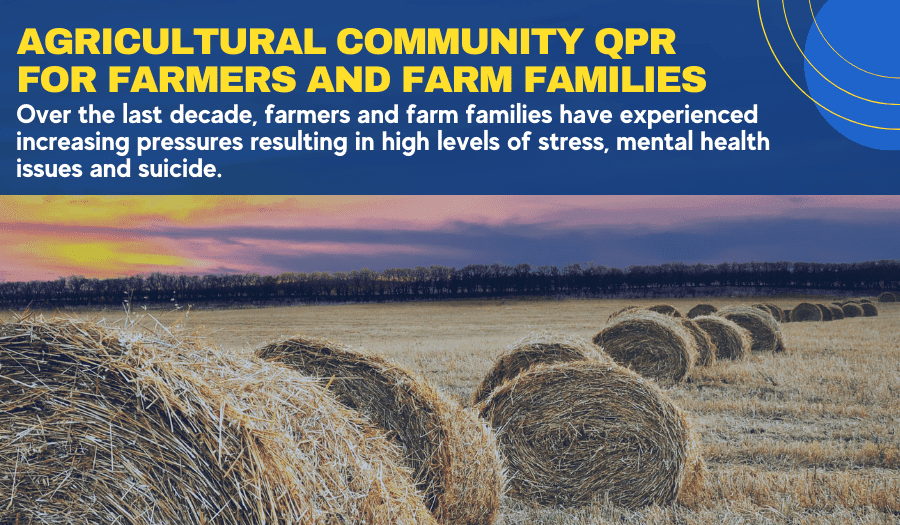
• QPR for Farmers and Farm Families

    What is QPR? QPR training teaches laypeople and professionals to recognize and respond to mental health crises using the approach of Question, Persuade and Refer. To attend this training participants must be 18 years of age or older. In this 1.5-hour QPR training, we will provide: - Information on the unique challenges farmers face thatRead More

  • QPR for Farmers and Farm Families

    What is QPR? QPR training teaches laypeople and professionals to recognize and respond to mental health crises using the approach of Question, Persuade and Refer. To attend this training participants must be 18 years of age or older. In this 1.5-hour QPR training, we will provide: - Information on the unique challenges farmers face thatRead More

  • The LandLogic Model: Why is the land so important to farmers and how do I incorporate it into my clinical practice?

    Recurring

    All seats have been filled for this training event.  If you would like to be notified when this training is offered again, please email Tara Haskins ([email protected]).  Summary: Driven by positive feedback from farmers and ranchers, this training discusses cultural adaptations to Cognitive Behavioral Therapy designed for clinical use with members of the agricultural community.Read More

  • QPR for Farmers and Farm Families

    What is QPR? QPR training teaches laypeople and professionals to recognize and respond to mental health crises using the approach of Question, Persuade and Refer. To attend this training participants must be 18 years of age or older. In this 1.5-hour QPR training, we will provide: - Information on the unique challenges farmers face thatRead More

  • QPR for Farmers and Farm Families

    What is QPR? QPR training teaches laypeople and professionals to recognize and respond to mental health crises using the approach of Question, Persuade and Refer. To attend this training participants must be 18 years of age or older. In this 1.5-hour QPR training, we will provide: - Information on the unique challenges farmers face thatRead More

  • QPR for Farmers and Farm Families

    What is QPR? QPR training teaches laypeople and professionals to recognize and respond to mental health crises using the approach of Question, Persuade and Refer. To attend this training participantsRead More

  • Webinar: Queer Farming: A Lived Experience

    Summary: The intersection of the identities of “queer” and “farmer” creates a unique set of challenges and inspirations for the people who inhabit it. Hannah will share her personal experienceRead More

  • QPR for Farmers and Farm Families

    What is QPR? QPR training teaches laypeople and professionals to recognize and respond to mental health crises using the approach of Question, Persuade and Refer. To attend this training participantsRead More

  • Webinar: Animal Depopulation Resiliency Check-in Tool

    Summary: Animal depopulation is associated with distressing psychological impacts on people. These impacts affect many stakeholders including veterinarians, producers, public health officials, and others who make decisions about and carry out depopulation. The Animal Depopulation Resiliency Check-in Tool (ADRCT) is a five-question public health protocol for stakeholders who are preparing for, participating in, and recoveringRead More

  • Webinar: AgriSafe’s FarmResponse: Looking Back at the First Year

    Summary: Launched in February 2022, AgriSafe’s FarmResponse is an on-demand interactive course through AgriSafe’s Learning Lab. The FarmResponse course addresses farm and ranching cultural competencies for healthcare providers and specialists by exploring the effects of financial stress, land ownership and legacy issues, substance use, suicide, and the work of agriculture on mental wellbeing. The curriculumRead More